Friday, September 17, 2010

Ramping up the mileage

With any sort of athletics, at some point, you have to start bringing up the effort at practice if you want to see progress.

That's been my goal for the past week: ramp up the effort.

Despite signing up for the Mankato Half Marathon in October, running has been consistently inconsistent in my schedule. I'd get a decent 8-mile day in, then I'd take 3 days off. This is partly due to schedule, but primarily due to desire. I want to do well in the race, but I don't want the training to consume my free time.

However, in the past week, I've made a more concentrated effort to work running into my regular schedule. I figured October 23 will be here before I know it and nobody wants to be the guy gasping for air and coping with leg pains at Mile 9.

Including the Norseman 5k run tomorrow, I will log 31 miles of running this week. A pedestrian amount compared to the number of miles I was putting in during training for Grandma's, but it's definitely progress.

The training runs this week included this fun little route on Thursday. Kind of just made it up as I went along. The route offers a killer hill (Main Street) and it takes you through a couple parks and MSU campus. It also offers a lot of side roads you can take to lengthen the run if you choose.

I will have to do longer runs than that in the next few weeks (it only wound up being about a 10K distance-wise), but the run helped convince me that I'm making progress toward race day.

Wednesday, September 15, 2010

Exercise for the mind: A trip to the library

Admittedly, I'm kind of a bookworm.

I bring a book with on most biking day trips, enjoy a good read while on one of the exercise machines at the Y, and even have a favorite reading spot in Mankato that I like to bike to (Weagel Park off the Red Jacket Trail).

So with time to kill on my day off earlier this week, I swung by the Blue Earth County Library and searched for books about biking in Minnesota. Considering my interest in the topic, I figured it would at least be material I'd enjoy reading and possibly give me ideas for bike rides to try in the future. Who knows? Maybe there's a cool ride in the Mankato area that I haven't experienced yet.

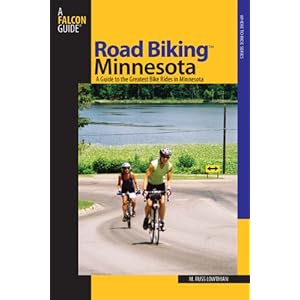
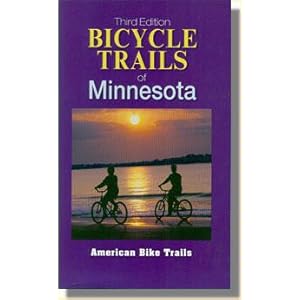
After a healthy amount of searching, I settled on two books to take home with me: Road Biking in Minnesota; and Bicycle Trails of Minnesota. The two books have similar titles, but each takes a different approach at describing cycling goodness in Minnesota.

The road biking book is probably my favorite of the two. It maps out 40 bike rides that the writer (M. Russ Lowthian, an avid midwestern cyclist) feels best encapsulates Minnesota as a state, ranging from 25-mile jaunts to 110-mile mega-challenges. Granted, there's an obvious skepticism that comes with any book that tries to label things as being the "best" (really, a matter of opinion), but Lowthian's approach in choosing and formulating the rides is both logical and fun to read.

He specifically avoids using bike trails whenever possible, instead opting for low-traffic back roads or roads with a deep shoulder for cyclists. This gives the rides room for creativity rather than relying on trails to guide them. Another appeal of the book is that the routes aren't just described by maps and elevation guides; Lowthian also lists points of interest, camping, food stops and bike shopes you can find along the way. Instead of focusing on distance and exercise, he focuses on the appeal of the journey (definitely a view point that's right up my alley).

There are three rides in the book that are relatively close to Mankato. There's the Blue Earth Challenge (an 82-mile loop that starts in Mankato and travels to Lake Crystal, Good Thunder and St. Clair); the Sakatah Cruise (60-mile loop between Elysian and Faribault in which half of it takes place on the Sakatah Singing Hills trail); and the Quad Park Cruise (a 52-mile loop that begins and ends in New Ulm). Those three rides, in addition to few other ones in the book, can be found here.

By comparison, the bicycle trails book is a lot more basic. It's part of the American Bike Trails series and thus focuses entirely on trails. Each of the 120+ trails in Minnesota is described with maps, parking lot listings, facility locations, and the occasional area attractions.

The biggest flaws in the book are its age (published in 2007, numerous trails have been completed or revised since then and merit updating) and its failure to list practical points of interest for riders. Maps and parking lots are essential information to find a trail, but that isn't the information needed to explore a trail.

For example, the listing for the Sakatah Trail has the campsite in Madison Lake and the bathroom facility in Elysian listed, but it doesn't include the Trail Blazer Bar & Grill or Tucker's Tavern, both of which are great places to eat along the trail. It also doesn't have nearby bike shops listed for any of the trails; information that could definitely come in handy for any down-on-their-luck cyclist (Lord knows it would have for me a time or two).

Perhaps I'm alone in this thought process, but I envision to ideal cycling book to be a mix of a park map and a tour guide. It should give a detailed map and description of a bike ride, then discuss the nooks and crannies that make said bike ride appealing.

It pretty much boils down to what you're looking for in the book. If you want logistical information on trails, the bike trails book is the way to go. If you're looking for ideas for adventurous rides you can go on, than Lowithian's book is what you want.

Both books are useful in their own way, but I found Lowithian's to be the more useful (and interesting) read of the two.

Thursday, September 2, 2010

Random bike ride brings random discovery

Similar to life in general, sometimes the most memorable workouts are ones that come about spontaneously without warning.

I wound up going for a fairly lengthy bike ride yesterday. I didn't plan for it. My initial intent was to bike over to the YMCA, get a solid hour of weightlifting in and run 5 miles on the treadmill. I figured I needed to start ramping up my mileage and getting back into running shape if I'm going to run the Mankato Half Marathon in October. Exercise is still a regular occurrence for me, but running has been sporadic since Grandma's Marathon in June.

As I was biking over to the Y, I randomly decided to hop on the Red Jacket Trail for a bit. Maybe I was tired of being cooped up in my apartment, but I figured a warm up bike ride couldn't hurt. Plus it was a beautiful day outside with little humidity and (more importantly) no wind. "Days like this weren't meant to be wasted in a gym," I told myself.

Once I biked past Mount Kato and reached the Red Jacket/South Route trail crossroads (where Highways 66 and 90 intersect), I opted to take a right and hop on the South Route Trail. I figured I haven't biked that way in awhile and it'd be cool to sneak a quick peak at Minneopa Falls. "You always bike on the Red Jacket Trail," I told myself. "You might as well do something different."

After arriving at Minneopa, I took my time to walk around the park, check out a few hiking trails and take a good, long look at the falls (sorry, no pictures, didn't plan on it so I forgot my camera). I hopped on my bike with every intention of taking the South Bend Trail back to the Y, but on my way out of the park, I saw signs for the Minneopa bike trail.

Like other Mankato cyclists, I vaguely remember hearing about the Minneopa trail through an article in the Free Press last fall. The trail was due to be completed this summer, but aside from a grand opening event planned for it on the Mankato Multisport Club's website, I hadn't really heard anything about it. Truth be told, I actually forgot about it. As my bike trip destination blog entries would indicate, it's not like there was a shortage of places for me to bike to this summer.

But since I was already at the falls, curiosity took over and I decided to hop on the trail and see how far it went. To my surprise and enjoyment, the trail is indeed complete, taking bikers all the way from Minneopa Park across the Blue Earth River into Sibley Park. It must have just recently been finished, as there's no information available about it on the web, nor does it even show up on Google Maps or mapmyrun.com.

The trail passes under a railroad and the access road into Land of Memories Park, making it a non-stop ride with no traffic to worry about. It also offers quite a few charming views of the Minnesota River valley as riders make their way into Mankato.

This was a pretty sizable undertaking for the parks department. The September Free Press article said the trail was a project 10 years in the making and its cost wound up being upwards of $1.4 million.

However, I'm sure I speak for all biking enthusiasts when I say that the hardships endured to build it are greatly appreciated. It's another beautiful trail to enjoy year-round and it creates an easier transportation pipeline to one of Mankato's greatest natural attractions.

I was critical of using bike trails to get to the falls area when I wrote about it in June because the South Route Trail took a meandering route to get there. Well, there's no more meandering to worry about anymore.

In a grander scheme, the Minneopa trail also creates a much more convenient transportation loop for any cyclist who wants to explore the Mankato area. It links directly to the South Route Trail, which in turn connects with the Red Jacket Trail. On the other end of it, after biking through Sibley Park, it also hooks up with the Minnesota River Trail, which eventually links to the Sakatah Singing Hills Trail. Here is a visual of all the trails in Mankato, sans Minneopa.

If you're keeping track, that's nearly 80 miles of linked trail that provides bike access to the following attractions: MSU campus, Rapidam Dam, Minneopa Falls, Seppman Mill, Mount Kato, Riverfront Park's concert area, the disc golf course at Land of Memories Park, a petting zoo in Sibley Park, the Old Town area in Mankato, and a historic high trestle railroad bridge. That's in addition to everything the 39-mile stretch of trail between Mankato and Faribault has to offer.

That's a lot of sights to see and a lot of pedaling to do.

Thursday, August 26, 2010

Plasma donation: Is it really bad for your health?

When it comes to differing opinions, there's nothing quite as polarizing as the act of donating/selling plasma.

"It's so bad for your health!"

"It's perfectly healthy."

"It'll damage your veins."

"It has no long-term side effects."

"It's not worth the effort."

"It's the easiest way there is to make some quick cash on the side."

I've heard it all since I started donating two years ago. At the time, I was fresh out of college and just needed some extra money to get used to adult life. I figured it was quick, easy and could work seamlessly around my schedule. Besides, my fear of needles (mostly) went away a long time ago.

Since then, it's become something of a vacation fund for me. I've paid for three separate vacations with it (including RAGBRAI) and am currently using it to save up for another in the undetermined future. It has also paid for a new set of tires, running shoes and the occasional nightlife excursion into downtown Mankato.

If you donate twice a week at the Mankato BioLife clinic, it's good for $180 a month ($20 per donation, plus a $20 bonus for donating at least once a week that month). Not bad for cash on the side. You can also take pride in knowing that the yellow-colored liquid coming out of your blood is being used to help treat several diseases (myasthenia gravis, Lambert-Eaton syndrome, Guillain-Barré syndrome and lupus are the ones most commonly listed on medical websites) for people with deficient immune systems.

However, there are some side effects to be aware of before embracing the needle. These are a few pointers based on my own experience donating:

  • Plasma is made up primarily of water and protein, so the process of donating does deprive you of those vital nutrients. Make sure you drink a lot of water leading up to the donation (particularly the day before) and add protein to your diet whenever possible. If your protein levels are low, you won't be able to donate (they check protein and iron levels when you check in at BioLife).
  • Like the more destructive activities involving needles (drugs, steroids, etc), donating plasma involves a needle puncturing your vein. There will be needle marks on your arms if you donate frequently enough and scar tissue can develop on your veins over time.
  • I've heard people say that donating plasma leaves them exhausted and too tired to do anything afterward. I haven't really experienced that. I wouldn't recommend going for a 10-mile run immediately after donating, but if you drink a bottle of water and grab a small snack, you should be fine.
  • There's a notion that the effects of donating (particularly the loss of protein) make it difficult to see any positive gains from exercise. I don't agree with that. If you're making protein a priority in your diet, it's easy to replenish. Plus, since donation scheduling is flexible, you can make it work around your exercise schedule. I've donating more plasma and ran more road races than I care to admit in the last two years, so I can attest that it doesn't have that much of a negative effect health-wise.
  • Aside from the aforementioned vein issues, the long-term effects are pretty minimal. Plasma replenishes quickly in your system and most facilities (BioLife included) return your red blood cells to you when the donation cycle is finished.
  • Avoid eating fatty foods or drinking pop or alcohol less than a day before donating. Drinking those can dehydrate you and fatty foods can make your plasma more difficult to extract. I made the mistake of going there after eating Pagliai's for lunch. Definitely not doing THAT again.

Of course, I'm hardly a credible health expert on the topic. So I consulted Dr. Pat Ruether, a local nutritionist, about it. Here is what she had to say:

  • The risks are relatively low, but do it cautiously. Make sure whatever facility you use has clean equipment and uses new tubes, needles and filters for every donation. There have been cases of donors developing a form of hepatitis at facilities with unsanitized equipment. According to the BioLife website, all facilities use new equipment with every donation.
  • The loss of plasma in your system leaves you more susceptible to the flu and other common colds, so Dr. Ruether recommends only doing it a couple times a month.
  • Confirming what I mentioned earlier, Dr. Ruether said the donations can cause damage to your veins over time, causing them to harden with scar tissue. Older donors are more susceptible to their veins not healing from the process, making them a greater risk.
  • The electrolytes from sport drinks like Gatorade actually help replenish your system faster, so it is recommended to drink something like that after donating.

I'm not saying everybody should donate plasma for extra money. It's definitely not for everyone and has its drawbacks. But the notion that it's damaging to your health is overblown.

Tuesday, August 24, 2010

Getting back into a routine

Routine can be a funny thing.

When you do it long enough, you start to get bored with it and pine for something different. But after straying away from it for awhile, you start to miss it for the solidarity it brought to your life and how it kept everything in order. The longer you stray, the more you miss it.

As regular readers can probably tell, exercise and working out are the routine that seemingly kept everything in order for me. It's not always the same bike route, running distance orweightliting set, but the consistency of the exercise goes a long way toward keeping me balanced.

For a variety of reasons, I've had a tough time getting back into a regular workout routine (and apparently blogging routine, apologies) since getting back fromRAGBRAI . I've never taken that long of a vacation before, so settling back in has been more difficult than I anticipated. I also switched apartments, dealt with an abdominal strain (much more painful that I thought it'd be), visited family and friends, and starting reading up on other biking adventures to take in the future (I confess, I caught the cycling bug onRAGBRAI).

Consequently, my "normal" exercise routine has been pretty lacking. I'll get a decent bike ride in here and there and find my way back to the weightroom at the Y on occasion, but it hasn't been what I'd call consistent. More often than not, I find myself contemplating a good workout, then stumble across something that seems more pressing at the time.

(Note: I recently found burned copies of "The Office" on DVD while unpacking that I didn't know I had. This counts as more pressing.)

Of course, the best remedy for this is as simple as a Beatles song lyric: Get back to where you once belonged.

So that's going to be my goal for the next couple weeks. I plan on making trips to the gym on a regular basis, going for bike rides when I can and getting back into a steady running routine. With the painful memories of Grandma's Marathon fading into the rearview mirror for me, I also plan on signing up for a few local races this fall to perk up my motivation.

Not sure what the culmination of workout routines will be (still debating between the half and full races for the Mankato Marathon), but I'm ready to get back on the horse. Or in this case, back into running shoes.

Tuesday, August 10, 2010

RAGBRAI photo gallery

RAGBRAI column (apologies for the hiatus)

Quick entry this time.

Here is a link to the column I wrote for Sunday's paper reflecting on the RAGBRAI experience. Obviously, week-long journey like that is difficult to encapsulate in a few hundred words, but it at least sort of touches on the experience. The trip really was the highlight of my summer.

I'm sure I will be participating in RAGBRAI again in the future. And if not RAGBRAI, at least a group ride similar to it.

I will post a photo album of some of the pictures I took during the week as soon as I figure out how to do so on blogger. Apologies to my readers for not posting anything this past week. It has been a hectic few days of family visiting (my brother and his wife recently had a baby) and cleaning (I'm currently in the process of moving).

I can assure my readers that I have not grown tired of writing about biking or anything else that avoids sitting still.
 

yaz