Saturday, July 24, 2010

Greetings from Sioux City

Two words to describe RAGBRAI so far: orgainized chaos.

My girlfriend (who was nice enough to drive me down to the start) and I got into Sioux City by 4 p.m. It took us until 6 to finally work out an amicable parking situation. There really wasn't much for signs around the campground directing us where to go and the majority of volunteers kept pointing us to different locations.
As luck would have it, the restaurant near the main campground (Bev's on the River) had a deal going where, for purchasing $20 in dinner tickets, we were given free parking in their lot for the evening. We also managed to find a parking spot within short walking distance from where we set up camp (see second photo). I guess the blind squirrel (or in this case, the novice RAGBRAI rider) finds a nut once in awhile.

Aside fom the parking mess, the rest of RAGBRAI has been a pretty cool sight so far. The downtown expo had several blocks worth of interesting RAGBRAI vendors (particularly t-shirts) that covered every need a cyclist could ever have. For those in the above-21 crowd, there were also plenty of places to "quench your thirst."

Another interesting aspect was the general diversity of groups riding at RAGBRAI. Some look like they came off the cover of Bicycling magazine, others look like your average family (as the first photo would indicate). Our tent is actually set up next to a group of riders from Tuscan, Arizona, further illustrating the diversity of bikers on this trip.
As far as evening plans go, I've already done the ceremonial "tire dip" in the Missouri River, where you dip the rear wheel of your bike into the water. After dinner, the plan is to figure out where the baggage truck is located and then head downtown to enjoy a little middle school nostalgia with Smash Mouth in concert.


Thursday, July 22, 2010

Packing for RAGBRAI

As my article on Tuesday indicated, the Register's Annual Great Bike Ride Across Iowa is just around the corner. I'm driving to Sioux City on Saturday and the week-long bike ride begins bright and early the next day.

Like any other first-timer, I'm a little nervous packing for RAGBRAI as it draws near. Unfamiliar events, by their very nature, carry with them an unfamiliarity about what to pack. RAGBRAI's website offers tips on the subject, but I've always felt such information is more of a useful guide than it is a definite statement about what to bring and what not to bring. There are obvious items that everyone should pack for something like RAGBRAI (toothbrush, soap and probably a bike), but other items are more optional based on
the person.

Do you need three changes of clothes for the week? More? Less? Do you need an air mattress to sleep? Would you want to read a book with your spare time? Is music an everyday necessity for you? Are you planning on going swimming at any point? Sh
ould you bring a camera?

These are just a few of the questions someone goes through when packing for something they've never done before. It's been a week-long debate for me as well. On RAGBRAI, you're allowed one soft-sided duffel bag to be shipped on a semi truck from town to town, and I've probably packed and re-packed my things a dozen times.


At first, I treated it like I was packing for summer camp all over again, but I came to realize that it's hardly the same thing.

Unlike summer camp, I'm not staying in the same spot every night, so quick re-packability is something to take into consideration. Another difference is in the priorities of the trip. At summer camp, I tried to earn Boy Scout merit badges; here I'm trying to bike across a state and chronicle the trip. So bike equipment and a laptop (makin
g blogging much easier) were priorities over hiking boots and my Boy Scout book. Cost-cutting maneuvers is another aspect to consider, as the majority of RAGBRAI's expenses come from the trip itself rather than the entry fee.

After much deliberation, I've broken down my packing needs into the following categories:

  • Campsite: tent, sleeping back, foam pad, flashlight, pocket knife, 30 ft of rope, bungee cords, lighter, camp chair, large garbage bags (for covering the bike and for a makeshift ground cloth when it rains)
  • Toiletries: shampoo/conditioner, soap, wash cloth, towel, toothbrush/toothpaste, deodorant, razor, washtub/laundry detergent/brush (saving costs on laundry)
  • Personal: 2 changes of bike clothes, 1 change of campsite clothes/sleeping attire, 5 pairs of socks, rain coat, swimsuit, sunscreen, bug spray
  • First Aid: aloe vera, antibiotic ointment, hydrocortisone, hand sanitizer, ibuprofen, Tylenol, assorted band-aids, Ace bandage
  • Bike stuff: 2 spare tubes, tube patch kit, tire levers, bike pump, allen wrench set, pliers, bike helmet, water bottle
  • Miscellaneous: wallet, cell phone, camera, laptop, book, mini football, box of granola bars (saving cost on food while biking), maps, notebook, watch, day pack, mp3 player, assorted chargers, frisbee
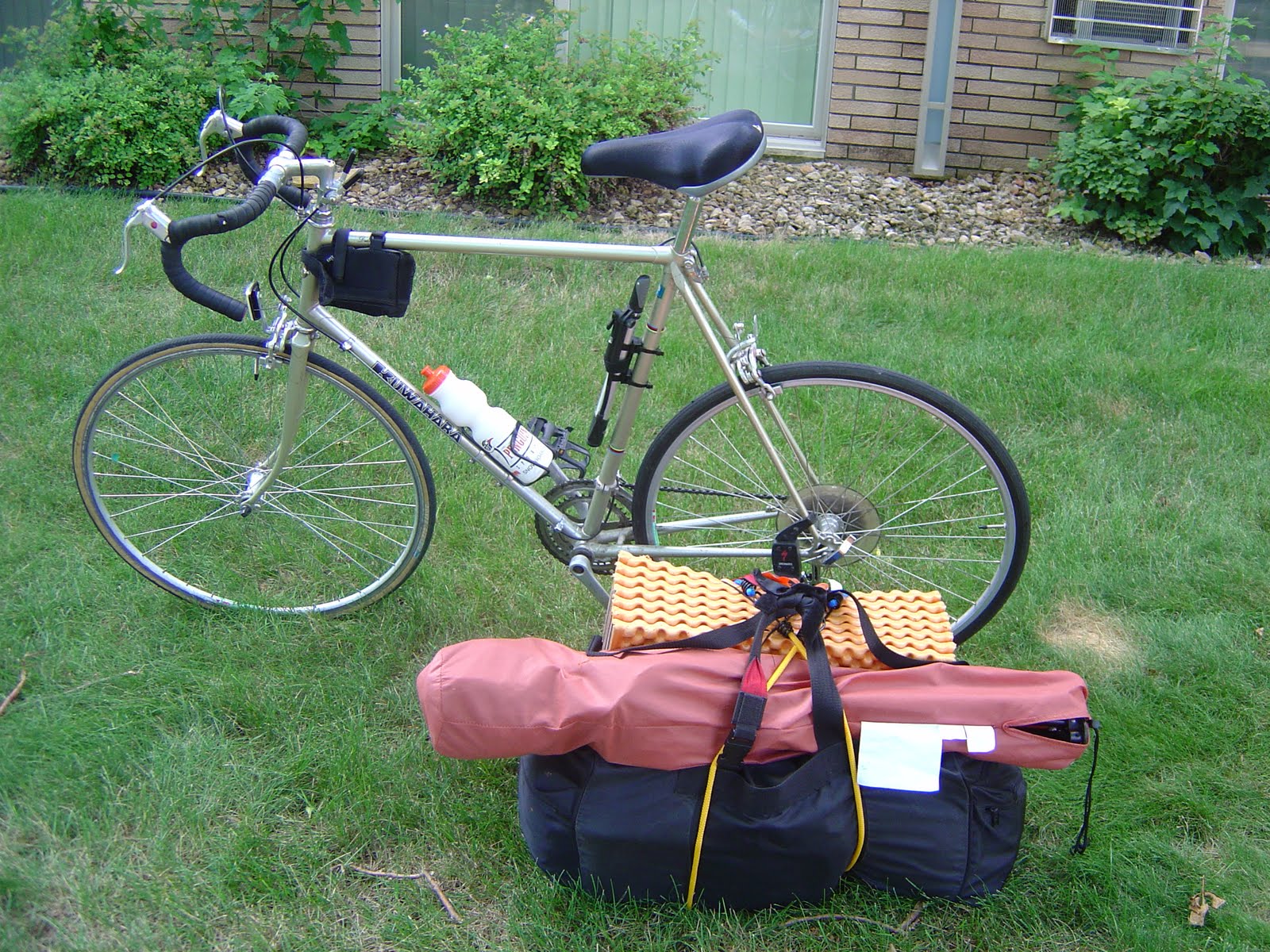
After getting all that stuff collected, next comes the task of making it all fit into one duffel bag. Thanks to wonderment of 2 gallon Ziploc bags, I've managed to compress down the majority of items that I'm capable of compressing. Ziploc bags also help water-proof the majority of my belongings, as it's sure to rain at some point during the week. The camp chair and foam pad are too bulky to fit in my bag, but thanks to bungee cords, I'm at least able to attach them to my bag.

There is also the consideration of things to pack on my bike everyday. It's good to be prepared for anything on the road, but it's also important to keep the weight light and the pedaling easy. I'm planning on carrying the following: bike repair items, water bottle, wallet, cell phone, granola bars, and my camera.

After all that planning and packing, here is how everything looks for the trip:


Hopefully I didn't forget anything major.

Monday, July 19, 2010

Bike trip destinations: Franke's (Kolacky) Bakery, Montgomery

Distance from downtown Mankato: Anywhere from 37-40 miles, depending on the route you take.

Route I took: The route I took to get there wasn't necessarily direct, but it did encounter the least amount of traffic. Essentially, you take the Sakatah Trail out of Mankato until you get to Madison Lake. After passing the Trail Blazer Bar & Grill, take the first left off the trail (1st Street/County Road 26). Follow that road for about 10 miles (the road goes through the Lake Henry/Lake Jefferson area and becomes County Road 15) into Cleveland. Once in Cleveland, take a right onto Highway 99 and follow that through Le Center for about 12 miles. Then take a left onto Highway 13, follow that into Montgomery and take a right onto Ash Ave. The bakery will be three blocks down on your right. The route I took to get home (taken because it was extremely humid that day and, in hindsight, I probably should've eaten more than Czech pastries during such a trip) was shorter (Highway 13 to Highway 99 to Highway 169) but also had a lot more traffic to be wary of.

General ease/challenge of ride: Aside from the occasional tree patches on the Sakatah Trail, the back country roads on this trip don't offer a whole lot of shade or wind cover. The distance of the trip is also not what you'd call a short ride. Hill-wise, I really don't recall anything daunting. The Sakatah Trail hill out of the river valley is pretty gradual and the only real noticeable inclines after that are between Le Center and Montgomery, none of which are overwhelming. By virtue of Montgomery being at a higher elevation, the return route is easier. However, I'd imagine the return route I took would be considerably tougher than my initial route if you were to use that to get to Montgomery. The hill down Highway 99 into St. Peter was extreme enough to get my bike up near 40 mph with little effort, so I can only imagine what that'd be like biking up.

Safety of the ride: Undoubtedly, the initial route I took is the safer of the two. For one thing, 14 miles of it is strictly on bike trails and thus more closed off from traffic. For another, the county road between Madison Lake and Cleveland was easily the least busy road I traveled on for that trip. Highway 99 was nerve racking to bike on because it was busy, drivers weren't obeying the speed limit (nothing makes a biker more nervous than a truck whizzing past them at 70 mph) and it lacked a wide shoulder at any point. Highway 169 was no picnic to bike on, as it was the busiest road of the bunch. If I were to do it all over again, I would've come up with a route that avoided Highway 99 altogether. It's just not a good road for cyclists.

Appeal of the destination: While interviewing the owner of Flying Penguin Outdoor Sports about RAGBRAI, I remember him talking about how the different towns in Iowa would have starkly different cultures. Well, if you're looking to find cultural differences close to home, look no further than New Ulm and Montgomery. The towns are only a mere hour from one another, yet one is heavily German for herritage and influence while the other is decidedly Czechoslovakian (see photo of town banner). A Czechoslovakian culture nut could have a field day walking around Montgomery during Kolacky Days, with everything from St. Johns Luthern Church's architecture to Czechoslovakian-attired dancers to Big Honza House in the downtown area.

While I'm always a fan of soaking in culture, I biked to Montgomery for one reason and one reason only: To get my hands on some quality kolackys at Franke's Bakery.

For the uninitiated, according to Montgomery's website, a kolacky is a small dinner roll-like pastry which is folded, enclosing filling in the center. Kolackys originated in Czechoslovakia when working men became frustrated that fruit in the open-faced buns would get all over their lunch buckets. The men had their wives fold over the pastry. Problem solved.

Admittedly, this served as something of a makeup trip for me. Montgomery's Tour de Bun bike ride is this Saturday, and it features recreational courses of 12, 30 and 50 miles in the
Montgomery area. The bike ride is part of Montgomery's annual Kolacky Days Festival which has everything you could possibly want in a festival: Carnivals, beer gardens, Czech food, museum tours, craft sales, tractor pulls, baking contests, softball tournaments, and a pageant.

Needless to say, the Tour de Bun is pretty much right in my wheelhouse for an event to sign up for. However, I'm unable to participate in it because I leave for RAGBRAI that day. So I decided to experience Kolacky Days with a little bike tour of my own. I figured I was unfamiliar with the famed Czech pasty and needed to get a good training ride in for RAGBRAI.
After getting to Franke's Bakery, it took me awhile to locate the kolackys. As far as appearance goes, they're really nothing special; they pretty much look like plain old dinner rolls. There were certainly more eye-catching bakery items in the store (I was practically drooling over the rasperry turnovers), but I didn't bike that far for a run-of-the-mill pastry. On the advice of previous visitors, I opted for a 6-pack of kolackys split into half apricot, half raspberry flavored pastries. I threw in a carton of chocolate milk with my purchase, reason that I needed something more than water to wash the pastries down.
After taking one bite of an apricot kolacky, I can tell you this: They may look simple, but their taste is far from ordinary. The bread of the Kolackys were freshly baked that day, and the rolls weren't skimpy with the filling either (see photo). Unlike the blandness of a creame-filled eclair, these pasty fillings had some real flavor to them. I can also venture a guess that since the pastries are bread and the filling is actual fruit, kolackys are probably healthier for you than your average doughnut.

Yes sir, the pastries were indeed tasty. However, they weren't quite worth an 80 mile bike trip through humidity hell. I had to stop for water every 10 miles or so along the way and felt like Tim Robbins at the end of the septic pipe in 'Shawshank Redemption' by the time I reached Mankato. I actually stopped to jump in Hiniker Pond on my way home just to cool down.

If I were to do the trip over again, I would either pick a cooler day, or I would do it during the actual Kolacky Days just to get more bang for the buck out of the trip. Or perhaps couple the Franke's visit with a trip to Big Honza House (I like saying the full name of the restaurant, it just sounds cool). Might as well immerse yourself in Czech food if you're going to bike that far.

Sunday, July 18, 2010

Inflatable kayak = fun overglorified floatie

I'll never forget my half-joking/half-serious reaction when my brother told me that he bought an inflatable kayak:

"So, did it come with an inflatable paddle?"

The concept of an inflatable kayak seemed weird to me. After all, in all my trips to the Boundary Waters, nobody ever broached the idea of inflatable canoe. Would you be able to steer an inflatable kayak? How would it hold up against the normal nicks and bumps with rocks and tree branches that are bound to happen? Can a normal-sized adult even fit into it?

Needless to say, I was skeptical that the floatie/kayak was functional. My brother kept telling me stories of how he kayaked down stretches of the Mississippi with it and brought it up the Boundary Waters, but stories only go so far in reassuring someone that something works. Infomercials might tell me that a juicer/blender/can opener "works," but I'm still not buying it.

So for the last two summers, my brother borrowed me his kayak to try it out for myself. It came with a carrying case (about the size of a large luggage bag, see second photo) an air pump and a legitimate kayak paddle (he told me he found the paddle, I didn't ask questions).

So far, I've tried it out on the Minnesota River and at Hiniker Pond in the Mankato Area. Contrary to my skepticism, it is definitely functional and gives you all the fun and exercise a normal kayak would. It's fairly easy to turn and navigate, inflates/deflates in less than 10 minutes and compresses down small enough where I can store it in my apartment and haul it in the back of my car. It's also considerably more durable than I thought it'd be (the boat landing at Land of Memories didn't even scuff the bottom of it). On top of that, the price is right (in my case, free).

That's not to say the inflatable kayak isn't without drawbacks. For one thing, it doesn't hold up well against strong currents (navigating up the Minnesota River was next to impossible). Also, like most floaties, it is more affected by wind than one would like. Because of the weight/balance difference from a regular kayak, it also doesn't roll over smoothly (meaning you would have to eject yourself from it like a canoe if it happened to tip). Aside from that, it's tedious to dry out.

However, considering the price difference and practicality of it (I'm not even sure where I'd fit an actual kayak in my living room. On top of my entertainment center perhaps?), the inflatable kayak works for me. And on a hot mid-July day, I could think of a lot worse ways to cool off than cruising around Hiniker in an overglorified floatie.

Tuesday, July 13, 2010

Bike trip destinations: Green Giant Statue Park


Distance from downtown Mankato: 45 miles from Mankato pretty much anyway you slice it.

Route I took: It's a pretty similar route to the one I took to get to the Amboy Cottage Cafe. Take the Red Jacket Trail to Rapidan, County Road 9 to Highway 66, Highway 66 to Good Thunder, County Road 1 out of Good Thunder and Highway 30 into Amboy. Once in Amboy, head south on Highway 169 and follow that all the way to Blue Earth. The park will be on your right (and fairly easy to find too, the statue is pretty big).

General ease/challenge of ride: Like the Amboy trip, there is some definite difficulty to take into account in terms of wind and lack of shade. The wind wasn't as bad the day I made this trip, but there wasn't a cloud in the sky and Highway 169 isn't exactly known for its canopy of tree cover. By the time I got home, the sunburn on my back was bad enough to the point that it's still peeling more than a week later. The distance is also something to be wary of, as it's a 90-mile roundtrip and certainly not for the faint of heart. One upside: The hills and elevation change are very minimal once you get out of Good Thunder. Most of the difficulty in my trip came from bike problems (see below).

Safety of the ride: For how wary I was about traveling on Highway 169 for an extended stretch, it really wasn't anything too nerve wracking. The traffic south of Amboy isn't nearly as bad as it is north of Mankato headed toward the cities and the shoulder is wide enough to give you adequate distance from vehicles. The parts of the trip that made me nervous were Highways 66 and 30 and County Road 1. As mentioned in a previous post, none of those roads have a shoulder to ride on and Highway 66 has tire strips on it to further narrow your distance from traffic. Thankfully, traffic on those roads is generally pretty mild.

Appeal of the destination: I spent the majority of a column I wrote last week talking about how the trip wasn't worth the destination. I wrote it as the sunburn was still scalding on my back and after I had just made it home before dark. I encountered three flats on the way down (a precursor to getting my worn-down tire replaced) and needed the assistance of a stranger at the self-proclaimed "World's Smallest Wal Mart" in Blue Earth to get out of that mess. There were no bike shops in town and the best advice a Wal Mart clerk could give me was that the nearest shop was in Fairmont (a lot of good that'll do with a flat tire). Really, it felt like way too much trouble to go through in order to see a 55-foot statue of the Jolly Green Giant.

While I still feel that way about the trip, my stance on it has softened somewhat. It is a LONG way to bike for a statue, but the Green Giant is an important slice of Minnesotan pop culture and a pretty cool historical landmark as well. Erected in 1978 to signify the completion of the transcontinental Interstate 90, the statue is also a representation of Green Giant and General Mills companies, both Minnesota institutions. According to most resources, the statue draws about 10,000 visitors every year, which is easy to believe because it is plainly visible from I-90. The park also has a gift shop and information center about the statue and Green Giant Vegetables, but it was closed when I visited (to the park's credit, it was pretty late in the day).

Other appeals about the destination: It's within walking distance of several places to eat in Blue Earth, it's near the historic Fairibault County Courthouse (erected in 1892, pictured right) and it's also a part of the Faribault County Fairgrounds. After a quick walk around the park (again, it was late and I needed to hit the road) I found out that the park has ample campground space, a good viewing area for live music and an area that looked like it could be used for either horse-pulling competitions or demolition derbies. Both will be going on at the Fairibault County Fair next week. For anyone packing a tent for a bike ride, camping at the fairgrounds is dirt cheap.

Wednesday, July 7, 2010

The first run is the toughest

The hardest part about running a marathon isn't necessarily the race itself, but rather summoning the motivation to get back out on the running trail after the race is over.

Mind you, I'm not implying that it's physically tougher. No training run could ever match the adrenaline rush that comes with an actual race. I'm instead talking about how mentally tough it is to "get back on the horse" running-wise.

Think about it. Once you sign up for a marathon, it's pretty clear what you're training for and when you're running the race. You develop a training routine, get yourself in shape and prepare yourself mentally for the big day as the race draws near.

But once the marathon is done, the motivation gets more difficult to channel. Your body is sore, you're mentally drained and, more than likely, you're burned out on running. So you take a break from it, but how long do you go until you break out the running shoes again? Like any other activity hiatus, it's hard to get yourself back into it once you've stopped.

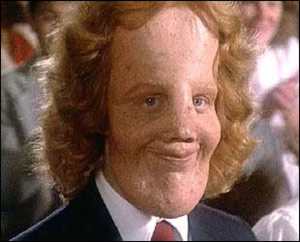
This is the dilemma I've been grappling with since Grandma's. I hadn't gone more than a day or two without running since last October. So you can imagine how stir-crazy I'd be after two weeks. I've been keeping active through biking and weightlifting, but running has not been in my routine. There is still some lingering pain in my legs and the blood blister on my foot, much like Rocky Dennis' face, is something that's beyond description.

But, like they always say, sometimes you've got to suck it up and get back out there. So after a workout at the Y a few days ago, I finally snapped out of my slump. I tied my shoelaces tight, stretched out my hamstrings and went for a run, my first real run since Grandma's.

It was far from glorious. It was on a treadmill, it was only 4 miles and I ran it at a pace that I would've considered snail-like during my training days. I have a long way to go to get back to level I was at before Grandma's.

But it's a start.

Saturday, July 3, 2010

Bike trip destinations: Amboy Cottage Cafe

Distance from downtown Mankato: 27 miles on back roads, and it's pretty similar distance-wise if you take Highway 169 the whole way as well.

Route I took: Only 6 miles of the route is on bike trails (Red Jacket Trail out of Mankato), but the rest of the route isn't too confusing. Just take a left onto County Road 9 when you get to Rapidan, a right onto Highway 66 and a right once you get to Good Thunder. Once in Good Thunder, take County Road 1 south out of town until it meets with Highway 30, where you take a right and follow for about 3 miles until you get into town. The cafe will be on your right.

General ease/challenge of ride: My opinions of the route's difficulty are skewed for two reasons: It was uncommonly humid out the day I took the trip and I had a 15 mph head wind blowing into my face for the entire way. It was also shortly after I ran Grandma's Marathon, so my legs were probably still recovering. Consequently, I had to hop off the bike and walk for a stretch after leaving Good Thunder. Looking beyond my circumstance, the route isn't that difficult aside from its sheer distance. The roads are generally pretty flat and traffic on the roads normally isn't too crazy. Beyond the distance, two factors make the route somewhat challenging: lack of shade and lack of any wind barrier along the way.

Safety of the ride: As mentioned above, traffic on the roads are generally pretty mild. However, there is still a safety concern, as none of the roads after County Road 9 have a shoulder to ride on and Highway 66 even has tire strips on the sides of the roads, further narrowing a biker's distance from traffic.

Another safety factor that came into play for my trip in particular was the weather. Due to ignorance on my part, I forgot to check the weather before leaving for Amboy, not knowing that severe weather was coming that evening. This was the same day as the vicious thunderstorm (and a few tornado sightings) that ripped through the Mankato area and even destroyed a townhome in North Mankato. The first hint of bad weather I had was around 5 p.m. when Amboy's severe thunderstorm siren started going off as I was leaving town to head home. I should've stayed at the cafe to wait until the storm blew over. But instead, I was worried about getting home before dark and decided to bike until I felt it became "too dangerous" out. Not the smartest move on my part. I made it home safely, JUST beating the hailstorm thanks to some adrenaline-fueled cycling on my part, but my narrow escape wouldn't have been necessary had I properly assessed the situation.

Lesson learned: Don't mess with Mother Nature when you're on a bike.

Appeal of the destination: When I first arrived in Amboy, I actually passed the cafe without noticing it. I had to get directions to it from a gas station a couple of blocks down the road. That pretty much sums up the size of the Amboy Cottage Cafe: Small enough to miss if you don't look hard enough. Believe it or not, the second photo is actually the entire indoor dining area of the cafe, though the cafe does offer outdoor seating as well.

Make no mistake about it though: This little cafe packs a pretty big punch.

I got to the cafe around 4 p.m., apparently perfect hours for someone to get a table because, according to the waiter, the place is usually packed during the evening. It is recommended to call ahead of time for reservations, as it's not only a popular eatery for Amboy residents, but for out-of-towners as well.

Not without good reason either. The food is expensive (my meal was $17 after tip) but worth every penny. Besides, as Marlon Brando probably said at one point: You can't put a price on good bread pudding.

The soup (I forget the name, but it had steak, potatoes and carrots in it, hearty fuel for a cyclist) was great, the chicken jambalaya was even better and their signiture dessert, raseberry bread pudding, practically knocked me out of my chair. I didn't even bother asking for the recipe of the pudding. Odds are, they wouldn't have told me and if they had, there's a good chance I'd weigh 300 pounds within the next year or so.

The chicken jambalaya was recommended to me by the waiter because it was basically spiced rice and chicken, a perfect combination of protein and carbs. But it is far from being the only good-looking item on the menu. The menu on the cafe's website is enough to make even the pickiest of eaters drool. I've heard from friends and locals around town that the cafe's breakfast is something special.

However, the food isn't the only thing that makes the cafe special. Its a quaint setting rich with Minnesota character and culture. Classical music from Minnesota Public Radio plays in the background, state-themed artwork and artifacts line the walls and Minnesota fact books are readily available for patrons to browse as they wait for their food.

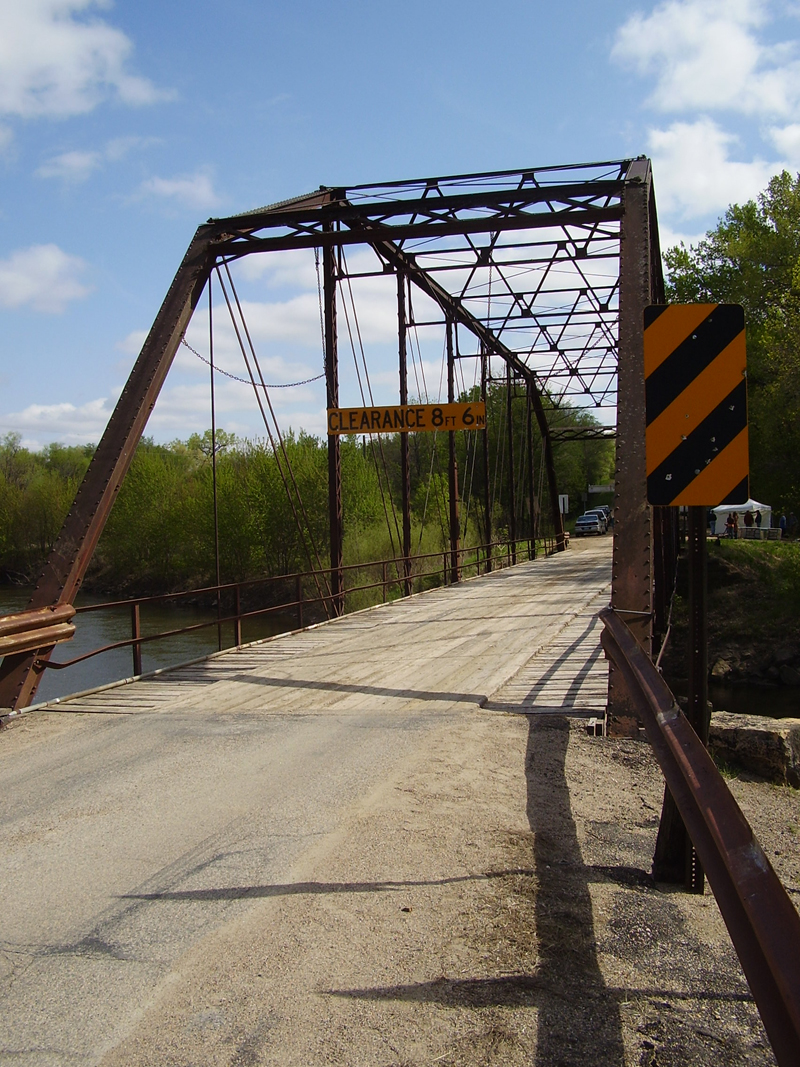
The cafe also has a nice little slice of history attached to it as well. The building was initially a cottage-style gas station built in 1928 before being abandoned years later. It was about to be torn down in 2000, but the cafe's current owner, Lisa Durkee, bought the property, relocated it and remade it into a cafe. Considering Amboy is a community that values and embraces its history (this is the same town that has the Dodd Ford Bridge, after all), the cottage cafe adds a lot to the culture of the town.

Another apsect of the cafe that I found interestng was its sizeable rack of coffee mugs on display in the dining area (see last photo on the right). According to the waiter, the mugs are actually purchased by patrons at $125 a piece. The catch: After buying a mug, you'll never have to pay for a cup of coffee at the cafe. The waiter told me that people from as far away as California have bought a mug from the cottage cafe. I guess they've got their cup of coffee situation figured out whenever they come to visit the Midwest. I won't be buying a mug for myself (definitely not a coffee drinker), but the Amboy Cottage Cafe will definitely be getting my business again in the future.
 

yaz